


Music Creation Stations: Acquisitions and Impacts

by Michael Stewart
InTune Monthly

EARLIER THIS YEAR, the In Tune Teachers Edition began publishing profiles of the work being done by KORG SoundTree to bring technology resources to classrooms. The first story was about the renaissance of KORG SoundTree products and services and followed up with one about “teaching with labs.” The piece you’re now reading is a third in the series, this time focusing on the evolution of keyboard labs into “music creation stations” with feedback from educators on what this has meant for students.
Wayne Splettstoeszer, Director of Instrumental Music/Music Technology at Torrington High School in Torrington, Connecticut has implemented the Korg Nano series—headlined by the nanoPAD2, nanoKONTROL2, and nanoKEY Studio. He says that this has marked, “a fundamental shift in both the aesthetic and functional ‘vibe’ of the modern music classroom.” And that, “These are not merely peripheral devices; they are purpose-built interfaces designed to align with the intuitive, tactile workflows of digital-native students.”

Sharon Selinger, M.Ed. is Band Program Director, Digital Music Librarian, Fine Arts Department iPad Administrator, Grade 5 Music Production and Grade 3 General Music teacher at the Pine Crest School - Boca Raton Campus in Boca Raton, Florida. The set-up she’s acquired also includes an interface, mics, headphones, nano controllers and drum pads, and she’s working on purchasing mini oscilloscopes and mini digital controllers to integrate STEM lessons.
Justin Francis teaches music at Ada S. Nelson Elementary School, Aeolian Elementary School, and Rancho Santa Gertrudes Elementary School in the Los Nietos School District, Whittier, CA. He’s implemented the KORG GEC5 system as part of a comprehensive keyboard lab, utilizing KORG SoundKey keyboards that are fully networked. “Students connect to the keyboards using Logitech headsets with integrated microphones, enabling two-way communication,” says Francis. “This setup supports whole-group instruction, individualized practice, one-on-one coaching, and small group collaboration—all while students remain in headphones, allowing multiple activities to occur simultaneously at different paces. Additionally, the keyboards are connected via USB and function as MIDI controllers for our after-school music production classes.”
In this setting, students engage with an online DAW, developing skills in recording, editing, looping, exporting, and mixing. The system’s flexibility allows it to support both foundational piano instruction and more advanced music production workflows. “Through our partnership with SoundTree, we were also able to expand our resources with additional equipment. Our elementary students utilize EVO 4 audio interfaces (pictured with students below), microphones, and stands for recording projects. At the middle school level, we incorporated 12 Novation Launchkey MK4 MIDI controllers, which are used in conjunction with Ableton Live to further enhance music production instruction.”
Justin's students capturing field recordings with their EVO4 audio interface
While Selinger wasn’t able to train on her gear and had to learn as she went along, that “working with Ken Greene from the SoundTree team was essential in developing new strategies and ideas for integrating music technology.”
Francis said, “Professional training played an important role in the successful rollout of our program. I participated in formal video onboarding sessions, one-on-one coaching with SoundTree representatives, and hands-on exploration of the equipment.” However, he added that like Selinger, “While these resources were valuable, the most impactful learning occurred through direct classroom application. Integrating the system into daily instruction provided practical experience in managing a full keyboard lab, differentiating instruction, and connecting the technology to real-world music production practices.
Splettstoeszer then gave a rationale for acquiring mobile technology resources.
“In a 1:1 environment, the “classroom” is no longer defined by four walls or a rigid row of fixed keyboards. The portable nature of these controllers allows a standard student desk to be instantly transformed into a professional grade production hub.
By moving away from static, heavy hardware, we are effectively “taking music off the bench” and putting it directly into the students’ hands. This mobile setup fosters a dynamic, flexible atmosphere in which students engage in hands-on sound design. Through the use of physical faders and pads, they achieve expressive control, real-time automation, and nuanced mixing that are simply irreproducible in a “click-and-drag” digital environment. The true power of the music creation station lies in its minimal physical footprint. Because these stations fit comfortably alongside a laptop or iPad on a standard desk, music can finally move beyond the dedicated rehearsal room and into the broader school curriculum.
Selinger commented that her program was acquired “through generous gifts made to the fine arts through our giving program.” Francis said that his program was shaped by a vision his superintendent, Dr. Ramiro Rubalcaba, placed before his team. He recognized that music and the arts are valuable parts of students’ social development and emotional well-being, and he challenged us to dream big as we built a new music program.”
We worked closely with district leadership and industry partners to design a space that would support both music literacy and practical, real-world skills.
When I reached out to SoundTree, it was because I wanted to strengthen the foundation of instrumental study through keyboard instruction while also allowing for greater student autonomy and differentiated pacing. The GEC5 proved to be the perfect bridge between music instruction and technology in our classrooms.
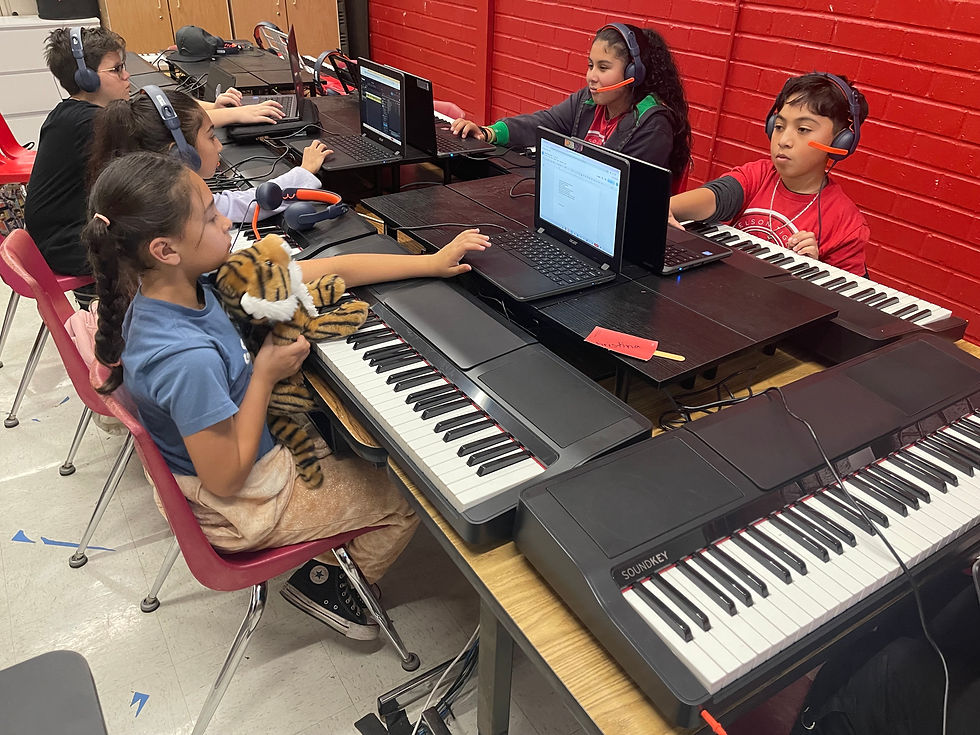
After receiving quotes for the labs, we used both ELOP funding and grant funding to purchase the necessary equipment. ELOP (Extended Learning Opportunities Program) supported part of the cost because of our plan to use the labs for after-school music production classes. All agree that the impact of their programs on students has been profound. Selinger said, “We’ve seen a significant increase in student agency , especially among those who might feel nervous performing. We’ve noticed an increase in students continuing with band electives (band, rock band, and jazz band) after the first year.
Francis offered that “The GEC5 environment creates immediate engagement. Students are not just learning about music—they are actively making it. It bridges traditional musicianship with modern production tools, which strongly resonates with today’s students. The result has been higher participation, stronger skill retention, and a deeper sense of ownership in their musical growth. The impact has been significant. Students who may not have initially connected with traditional ensembles are finding their place through music technology. I’ve seen increased confidence, creativity, and collaboration.
Students are composing, producing, and performing at levels that were not previously accessible in a general music setting. The program has also opened doors to career awareness in music production, audio engineering, and digital media. We live in a world full of digital consumers, but we need to train and inspire the next generation of digital creators. This program has given our students a dedicated space to do exactly that.
As for their advice to other schools and educators contemplating the acquisition of technology for music education, Selinger suggests, “Don’t be afraid of the tech. The gear is there to facilitate the music, not replace it. Start simple and gradually incorporate more complex software as you and your students get comfortable. Francis adds, “Start with a clear vision but stay flexible in how you carry it out. Focus on student engagement first—technology is the tool, not the goal. Establish clear procedures for how students will use both computers and keyboards together, since that structure helps overcome many of the common challenges in a lab-based setting. It is also worth exploring whether after-school funding is available, especially if you are considering launching a music technology program beyond the school day.
There are so many great teaching resources available, so take advantage of them. Invest time in classroom management strategies specific to a lab environment, and do not hesitate to introduce creative, project-based learning early on. Most importantly, connect your program to real-world applications—whether that is performance, production, or industry pathways. When students understand the “why,” everything else accelerates.”
Thanks to Irwin Kornfeld and Michael Stewart from InTune Monthly!
In Tune Partners Westchester Media
Etymotic Education
P.O. Box 166
Thornwood NY 10594


Comments